
Mockingbird Hill: A Key Piece of the Recovery Puzzle
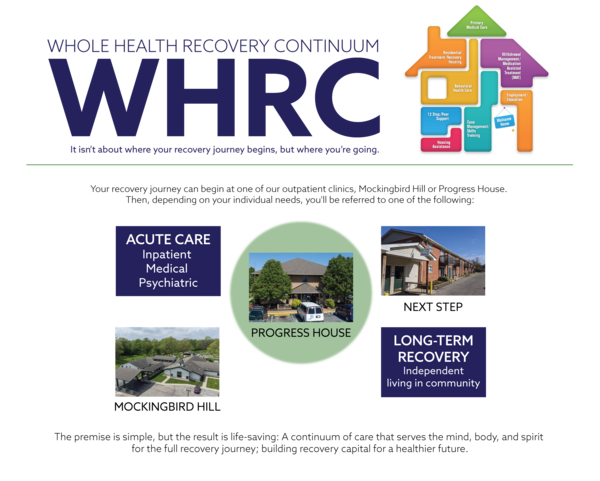
When Aspire Indiana Health and Progress House merged in November 2019, it was the first step in launching Aspire’s Whole Health Recovery Continuum (WHRC) to address substance use disorder (SUD), a complex problem with multiple causes.
“Five years ago, Aspire wasn’t offering addiction treatment and recovery support services in a residential setting, and now we have the most extensive residential recovery continuum in Indiana,” says Aspire Vice President of Recovery Capital Darrell Mitchell.
A key piece of that recovery continuum is Mockingbird Hill, Aspire’s substance use treatment facility offering onsite primary medical and behavioral healthcare, Medication Assisted Treatment (MAT), withdrawal management, individual case management, peer support groups and 24/7 care and supervision.
“For years we talked about the challenge of men coming to us and saying they were ready to get clean and sober,” Mitchell says. “But at Progress House, you have to be abstinent from drugs and alcohol for a certain amount of time before becoming a resident, so for those individuals in active use and without financial resources, there wasn’t anywhere to send them. We knew there was a missing component of the continuum.”
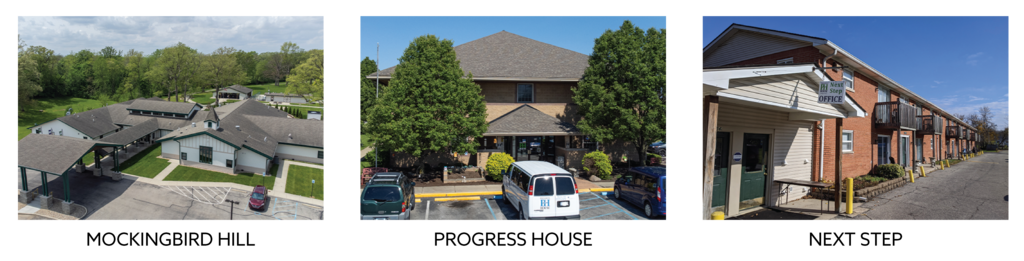
Mockingbird Hill Recovery Center was the much-needed solution. In 2020, the decision was made to purchase a property located on a 17-acre campus of trees and rolling hills in Anderson, Ind. This center was designed to be different from other treatment centers, with a clear mission to serve people from every walk of life, regardless of income, providing a beacon of hope for those in need.
“Many addiction treatment facilities do not accept Medicaid, and we wanted Mockingbird Hill to be that answer for those individuals who needed high-intensity treatment in a residential environment who may not have the resources to access care,” Mitchell says.
Since its opening in March 2021, Mockingbird Hill has been a gateway to Aspire’s whole health recovery continuum. It also includes Progress House, a residential recovery housing program, and Next Step, a sober living apartment community available to those who have successfully completed the program at Progress House.
Once an individual fills out an online application for Mockingbird Hill or Progress House, Aspire clinicians and operations staff assess that person to decide what level of care is needed, given the nature of the person’s SUD as well as emotional and physical status. A personalized treatment plan includes a recommendation for the proper venue for services — whether outpatient or residential — along with the extent and types of services needed to maximize the opportunity for long-term recovery.
Many times, individuals continue in and out of treatment facilities because they haven't had the appropriate next step of recovery support needed.
“Aspire offers support for our clients’ recovery journey,” Mitchell says. “And in every part of that journey, whether in our residential facilities or outpatient clinics, our staff plays an important role in providing the care and tools for long-term recovery and independent, meaningful living in the community.”
Some individuals may start their journey at Mockingbird Hill, where clinical services are offered and recovery principles are introduced. After the average 28-day stay at Mockingbird Hill, programming can continue at Progress House for the next five to seven months, where individuals still receive treatment services but are now in a recovery environment with a recovery culture.
Others start their journey at Progress House, where there are fewer group and individual therapy hours but more one-on-one recovery coach time and daily 12-step meetings. Some graduates then go on to Next Step, where they can stay for up to two years. No where else in the state can someone enter treatment, move on to recovery housing and then transitional housing in a sober environment in a seamless continuum.
Although the facilities are linked in Aspire’s continuum of care, there is a misperception that only Mockingbird Hill graduates are eligible to become residents of Progress House. This is inaccurate, as Progress House served men from 62 counties last year. There are also times when applicants for Progress House find that after an assessment, they are not ready to live in a recovery residence and would benefit from a program like Mockingbird Hill.
“A high percentage of clients at Mockingbird Hill go to Progress House, and after successful completion, can either go back into the community and continue outpatient services or go to our Next Step apartments, a recovery community that offers more independence but with structure and accountability,” Mitchell says. Next Step residents regularly visit Progress House to sponsor and mentor those going through the program.
“There is a popular saying in the rooms of recovery, ‘You have to give it away to keep it.’ Next Step residents and other Progress House alums return to the House because their lives have been changed at Progress House, and they want to share their experiences with the men just beginning their recovery journey — showing them there is help… and hope.”
Mitchell continues, “Another thing that makes the Whole Health Recovery Continuum unique is our staff. Several patients who started their journey at Mockingbird Hill have returned there to work in some capacity. The same is true for Progress House, as all operations staff are former residents. It is critical in both facilities to have people with lived experience on staff. It's even more powerful when they share with our clients that they were former residents themselves.
“Our staff at both facilities includes clinicians who did their internships at Progress House and are now Aspire employees working at Mockingbird Hill or Progress House. We also have two recovery coaches at Progress House, Bennie Williamson and Jimmy T, who have been on staff for 20 years and 15 years, respectively. That is unheard of in the recovery support space. We are fortunate to have such dedicated and talented staff at our residential recovery facilities. We have a fabulous continuum and our outcomes reflect that. Truly, it’s a privilege to do this work.”
